
How many paper bags fit in a container? I would not give you a reliable number until I know how those bags are packed. A large order can look economical on a unit-price sheet and still use more freight space than expected. At Golden Sleeve, I start paper bag container loading discussions with the finished bag and export carton, then work toward the shipment. Below, I show the calculation I would use for an initial review and the information needed before a loading quantity becomes part of your quotation.
Planning an order? Send your product, quantity and destination for a sample or quotation review.
In this guide
1. Start paper bag container loading with the finished bag
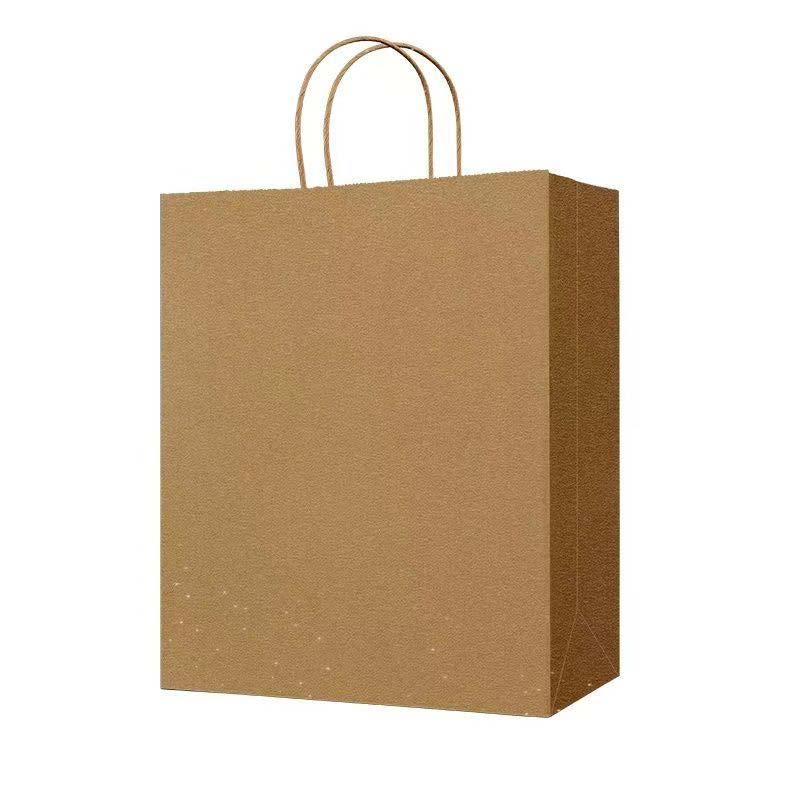
Confirm bag width, gusset, height, handle type and any printing before discussing a container total. A different handle or fold can change the thickness of the packed bundle. The same nominal bag size does not guarantee the same number of pieces in an export carton.
Our kraft paper takeout bags are listed with 120 gsm paper and custom sizing. I would request the packing proposal for your selected specification rather than borrow a carton count from a different project. If you are still selecting the bag itself, use our takeout bag size guide first.
2. Request the four packing figures that drive the estimate
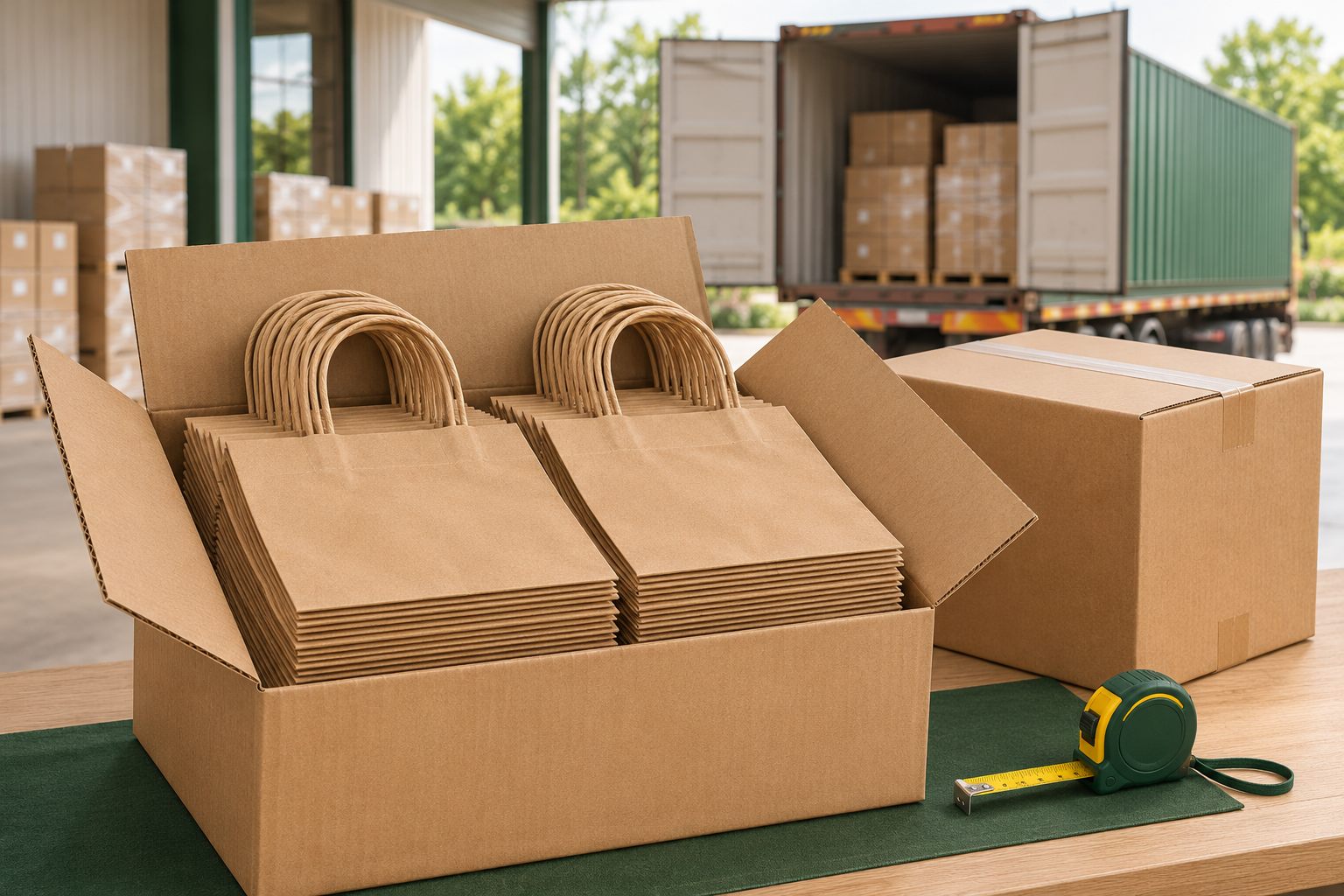
For each paper bag container loading estimate, ask for pieces per carton, external carton length by width by height, carton gross weight and the proposed loading method. Identify whether the figures are measured from a packed sample or are still preliminary. Keep the measurement units explicit.
Use external dimensions for freight planning. A carton’s internal usable space and its outside shipping volume are different measurements. If two suppliers quote different packing counts, compare the entire proposed pack instead of assuming the higher count is automatically more efficient.
| Required figure | Why I need it |
|---|---|
| Pieces per carton | Converts cartons into saleable bag quantity |
| External carton dimensions | Supports volume and layout planning |
| Gross weight per carton | Supports payload and handling review |
| Pallet or floor-loading plan | Identifies the space occupied by the actual load |
3. Calculate carton volume before paper bag container loading
Convert each dimension to meters, then multiply length by width by height. For example, a hypothetical 600 × 400 × 400 mm export carton occupies 0.600 × 0.400 × 0.400 = 0.096 cubic meters. CBM is simply cubic meters.
If that illustrative carton holds 250 bags, its shipping volume per bag is 0.096 ÷ 250 = 0.000384 cubic meters. This is a planning comparison, not Golden Sleeve packing data. Ask for the actual carton specification before using any result to order freight.
For paper bag container loading, I keep the calculation beside the packing reference. This helps catch a later change from one carton size to another before an old spreadsheet becomes the basis of a new order.
4. Work through a quantity example without promising a load
Suppose a forwarder provides a preliminary 60 cubic meter planning allowance for a particular shipment. That is a hypothetical allowance, not the rated volume of a named container. Dividing 60 by 0.096 gives a volume-only ceiling of 625 cartons. At 250 bags per carton, that ceiling is 156,250 bags.
Now suppose the confirmed layout accepts only 600 of those cartons. The resulting order would contain 150,000 bags and occupy 57.6 cubic meters of carton volume. If each hypothetical carton weighs 12 kg gross, the cartons alone would total 7,200 kg, before any pallets or additional securing materials.
The lesson is that paper bag container loading needs both arithmetic and a physical layout. Volume division does not tell us whether whole cartons fit through the door, stack in the available height or comply with the booked equipment’s payload.
5. Check pallets, stacking and destination handling
A palletized shipment and cartons stacked directly in the container use space differently. I would ask the receiving warehouse what unloading equipment and pallet requirements apply before selecting the method. A few additional cartons are not helpful if the buyer cannot receive the load efficiently.
Have the supplier and forwarder confirm carton orientation, permitted stack height, load stability, door clearance and securing requirements. Do not rotate or stack a carton solely because the spreadsheet finds more space; the packing must remain suitable for the goods.
For paper bag container loading, also discuss moisture protection for the intended route and season. Paper packaging needs an appropriate shipping plan, but I would not prescribe one universal treatment without the actual cargo and transit details.
6. Recalculate paper bag container loading for mixed orders
For paper bag container loading with two bag sizes, prepare a separate packing line for each. Add cups, lids or bowls as separate items rather than applying the bag carton count to the entire order. Their dimensions and packing arrangements can differ significantly.
I would ask for a loading plan listing the proposed cartons and pieces by product code. Compare that plan with your required sales mix. Maximizing the number of bags is not useful if it leaves you short of the larger size your customers need most.
Keep delivery responsibility visible too. State the destination and requested trade term when comparing quotations. Our US-based support does not by itself establish a particular delivery service, payment arrangement or warehouse option for every international market.
7. Turn the estimate into a reviewable shipping brief
My preferred paper bag container loading brief includes approved bag dimensions, quantity by design, packed-carton measurements, gross weights, loading method, destination and required arrival window. Ask the supplier to identify any assumptions that remain open.
Before booking, reconcile the confirmed packing list and forwarder’s loading plan. Keep the final carton and piece counts with the shipment record. When a future order changes the handles, paper or case pack, recalculate rather than reusing a remembered container total.
Buyer questions
What changes a paper bag container loading estimate?
No. The finished bag, carton dimensions, pieces per carton, payload and loading arrangement determine the proposed quantity. I would request an order-specific loading review.
Can I calculate the load using bag dimensions alone?
Bag dimensions are the starting point. I still need the folded packing format, carton dimensions and pack count before estimating shipment quantity.
Can Golden Sleeve quote less than a full container?
Send your quantity and destination for review. Available shipping methods and commercial terms need confirmation for the specific project.
Send us a brief we can quote against
Send the finished bag size, handle style, artwork status and quantity by size. Add your destination and tell us whether you already have a forwarder, a pallet requirement or a target shipment size. If you have a packing list, include the carton dimensions and gross weights.
Request a specification review and written quotation, or email bill@golden-sleeve.com. For international projects, include the destination country, postal code or port and proposed delivery term. We will review the available product and shipping options for your project. Minimum quantities, sample availability, lead time, delivery scope and final pricing require written confirmation.
Technical reading: Jorange’s carton-based bag loading guide and EcoWing’s packaging shipment planning guide. These independent references explain buying methods; they do not establish Golden Sleeve specifications or commercial terms.